
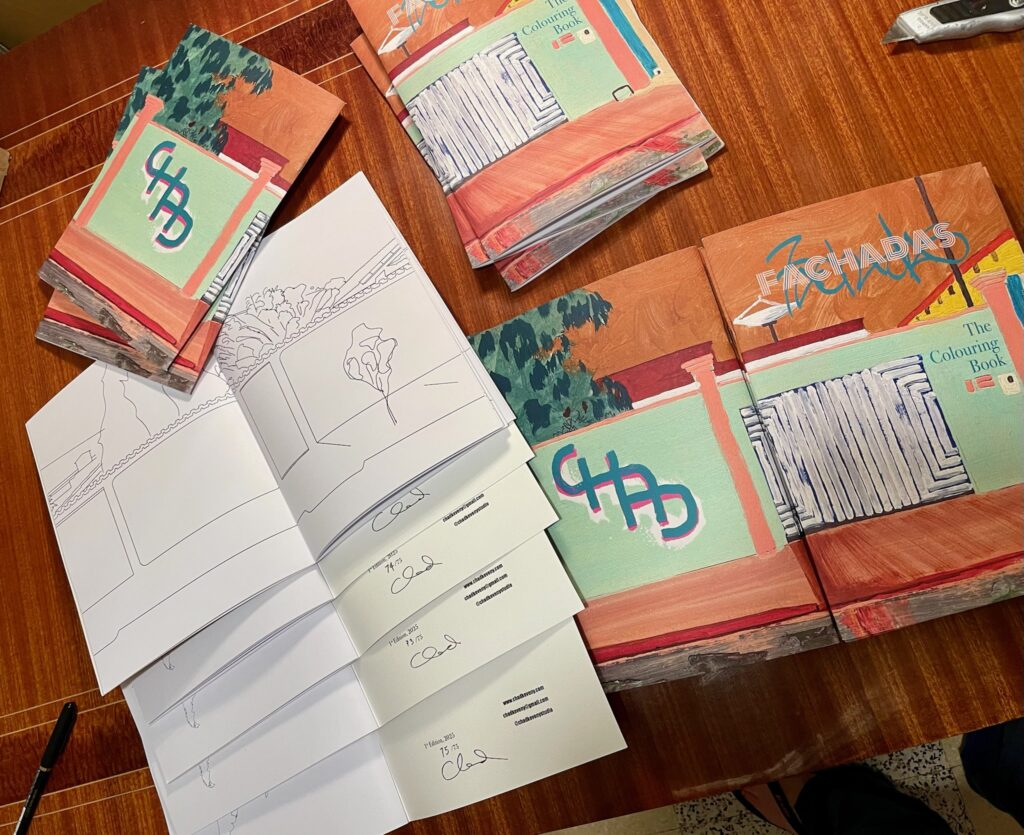
Fachadas: The Colouring Book
Walls that talk back
In 2016 I spent time in Colinas do Tocantins, a small town in the Brazilian interior that exists, more or less, because of a railway line. The line carries soy out to the ports. Everything else in the town has arranged itself around that single fact.
I was there for a reason that had nothing to do with art at first. My uncle Marty, an Irish missionary, had lived there for 26 years. I went hoping to find something like a state of nature — open streets, daily life spilling outward the way it does in so many Brazilian towns.
Instead I found walls.
Not the streets of São Paulo, loud and exposed. Here the streets were empty. Houses turned their backs to the road. No windows, just wall after wall, broken only by the occasional satellite dish, a glimpse of a tree pushing up over a parapet, the wash of a passing car. It wasn’t poverty exactly — it was insecurity, a very specific, very rural kind, where the response to risk is to build a perimeter and disappear behind it. Everyone, in their own way, building a small castle. A modest, defended, middle-class dream.
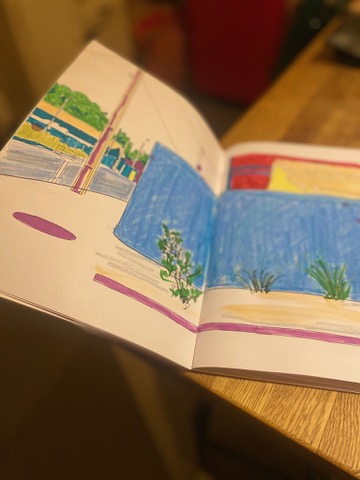
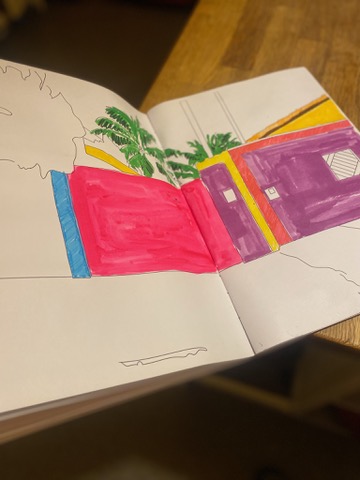
So I started drawing the walls. And painting them — not as records, but as lyrical abstractions: flat planes of colour interrupted by loose, open bursts of vegetation breaking the geometry. The buildings became a kind of grid; the plants became the only improvisation allowed inside it.
Fachadas is what came out of that.
What the book actually is
It’s an A4 colouring book, full-page spreads, limited to a first edition of 75 signed and numbered copies.
Open it and you get two things at once. There are the big, flat façade shapes — walls, shutters, gates, the architecture of withholding — built for bold, confident colour. And tangled into them are the looser organic forms: a tree breaking over a ledge, a stray plant climbing through ironwork. One half of the book asks you to commit to a colour decision. The other lets you go loose and lyrical. Move between the two and you start to feel the same tension I was drawing into for weeks out there — control and wildness, sharing a single wall.
Front and back, there’s context: where Tocantins actually sits, how the soy economy shaped this particular kind of town, the wider weight of Amazonian deforestation behind it, and the personal thread that put me there in the first place — my uncle’s 26 years as a missionary in a place I’d otherwise have had no reason to find.
Fachadas — The Colouring Book, 1st Edition, 2025. Limited to 75 signed and numbered copies.